1920s Locomotives.

1920s Locomotives.
Lord Nelson and Gladstone, May 1927..

Wednesday, 16 April 2014

172-190 Later H15s and S15s.


In 1924, production of H15s restarted, including the rebuilding of 330-334 former F13s. The running boards are now level and not stepped. These three classes were a family with many interchangeable parts - H15 and S15 as mixed traffic, and N15 as passenger engines. At this stage the N15s were not given Arthurian names.

172. Southern 334, , Class H15 rebuilt from class F13.

173. Southern E521, Class H15

174 Southern E473, Class H15 (Locomotive Publishing Co)


 175. Southern E521, Class H15

 176. Southern E476, Class H15

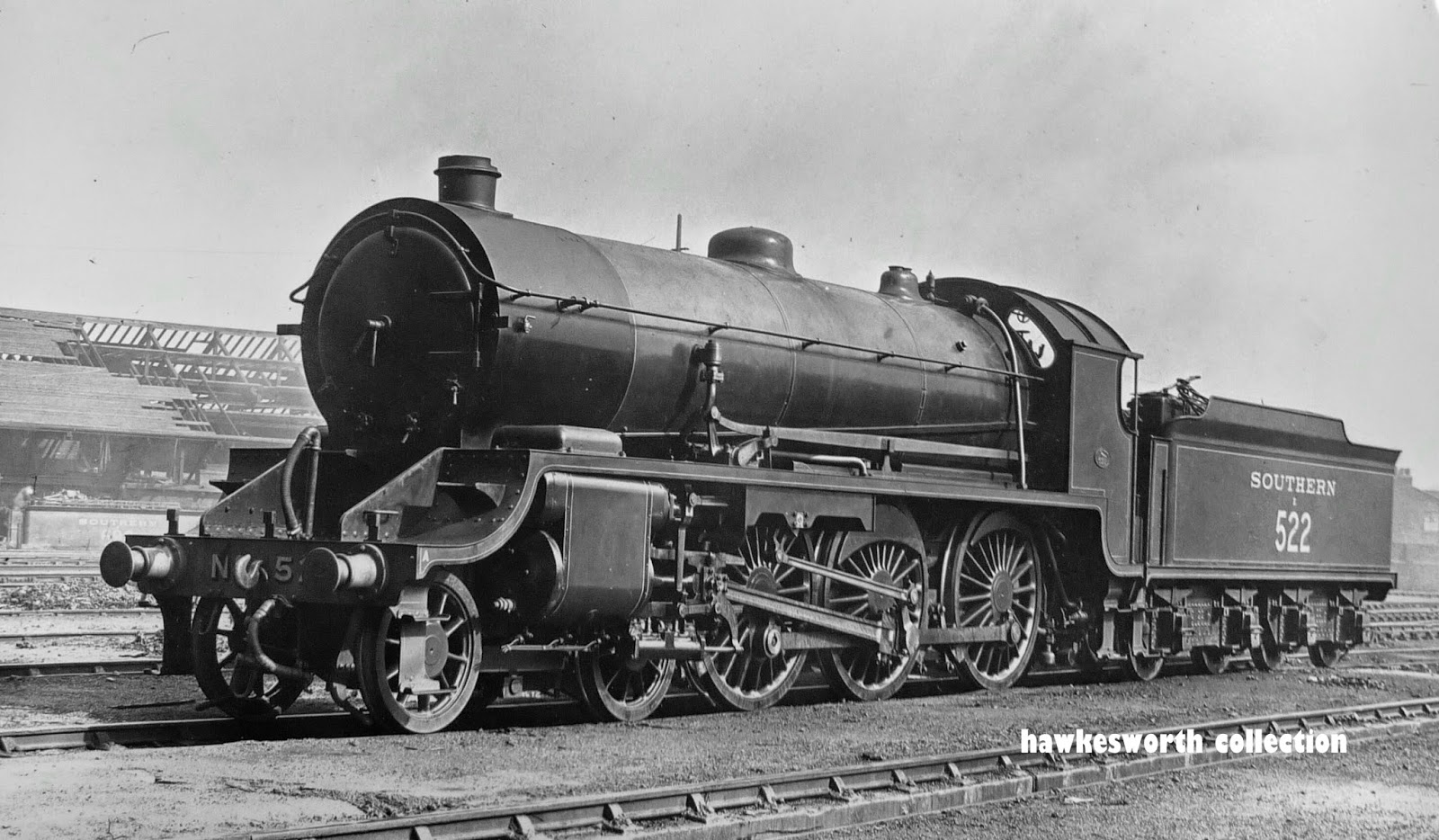
177. Southern E522, Class H15.

178. Southern E334 wearing 1930s blinkers. 330-334 were rebuilt from Class F13s.

179. Southern E 522 Class H15.
180. Southern E473 Class H15.

181. Southern E476 Class H15.


 182. Southern E330, rebuilt from an F13.

183. Southern E524 Class H15.

184. LSWR 498 Class S15, around 1920.


185. LSWR 499, Class S15 (Locomotive Magazine)

186. LSWR 507, Class S15 (O J Morris)

187. LSWR 508, Class S15 (Locomotive Publishing Co)


188. LSWR 507, Class S15  (Locomotive Publishing Co)

189. LSWR 825, Class S15 (Locomotive Publishing Co)

190. LSWR 833, Class S15 (F Moore's Railway Photographs)

To be moved to King Arthur post   later

 Southern E778  Sir Pelleas (Locomotive Publishing Co)

Southern E453 King Arthur. (Locomotive Publishing Co)

Southern E782  Sir Brian.

Southern E764 Sir Gawain (F Moore's Railway Photographs)


Tuesday, 15 April 2014

161-172 The 1914 H15s.

On Drummond's death, Urie took over and began a serious shake-up of the LSWR locomotive stock. The first move was to design a batch of 4-6-0 mixed traffic locomotives, the H15s. This began in 1914 but was then held up by the war. This post features those 1914 introductions, numbered 482-491, plus 335.

161. LSWR 482, Class H15.


162. LSWR 483, Class H15.


163. LSWR 484, Class H15.

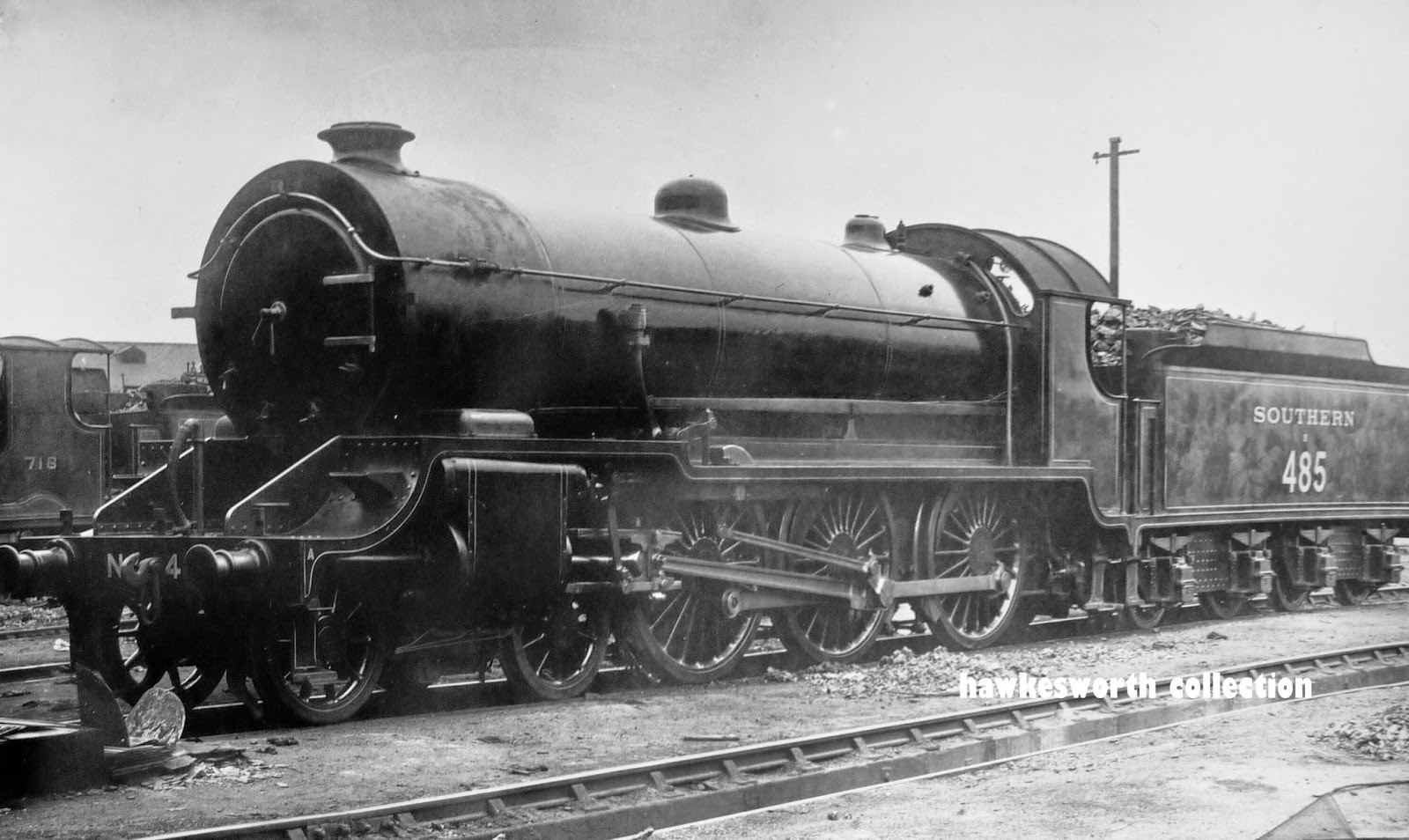
164. LSWR 485, Class H15.

165. LSWR 486, Class H15.

and in Southern days


167. LSWR 487, Class H15.

168. LSWR 488, Class H15.

169. LSWR 489, Class H15. Geoff: 169 : "Up Bournemouth" F.E.Mackay, pub RM Feb 1915. The presence of the juice rail, position of the box and the shallow cutting, suggest Earlsfield. 


170. LSWR 490, Class H15. (Locomotive Publishing Co)


171. LSWR 491., Class H15 (Locomotive Publishing Co)


172. Finally, as reported elsewhere in this series, the Drummond E14 LSWR335 was rebuilt into the last H15 by December 1914. Its near-sister locomotives LSWR 330-334 would have to wait till after the war.

Tuesday, 8 April 2014

146-160

146. Peter Smart: Photo 146 Eastleigh Paint shop February 1913. The lack of activity suggest a Sunday and access for official photographs. The clue to the date is the presence of D15 472, the last of the class which was out shopped in February 1913.
To the left is Number 665, an Adams X6 and behind the an Adams "Jubilee" A12 class which might be 584. I can't see the number clearly enough to be certain but it looks like the two digit that are visible are 84. Perhaps you, Stephen, can use an eye glass on the original photo please. (Confirmed as 584, Stephen)


147. The back reads: Beattie's early goods loco. Under magnification, the top line of the brass plaque says Beattie's Patent, and underneath 'Beyer Peackock Ltd, Manchester'. An impressed stamp on the original (visible in this print) reads J N Mudd, Manchester, a photographers mark.The middle line has 1908 which I first took to be 19th August but may be the year. However, the word after it is something like FREPL. James Mudd was an esteemed Victorian photographer (http://www.mosi.org.uk/media/33871134/jamesmudd.pdf) who took photographs for Beyer Peacock from 1856 (his wife's maiden name was Peacock). The early ones were albumen prints, which proved unstable. He soon used the dry collodion process, with which this print was made. This was exposed onto a glass place, but required an exposure time of several minutes. This process later speeded up when the glass plate mix used gelatin after the 1870s. James Mudd's portraits and landscapes are still traded. He died in 1906 but his company continued through his son (James Willis Mudd) and later his assistant George Grundy. This postcard is by the Locomotive Publishing Co. Similar locomotives were made for the Midland Railway, and several to Dutch Railways - https://www.flickr.com/photos/mopa1/5710949855 and http://www.victorianweb.org/technology/railways/l13.html  At least one went to the Isle of Man. 


148.

149. Carriages...

(F Moore's Railway Publications)

150. The back reads (unfortunately written in biro) 720. Southampton Dock. August 1899. This is an interesting prototype Drummond engine, built 1897, classified 4-2-2-0 (i.e. independent uncoupled driving wheels) the only member of Class T7, five similar engines (369-373) being built in 1901, Class E10. Nicknamed 'double singles'. More information on www.railuk.info.   Note also the luggage trolleys in the background.

151. Other pictures of Class T7 4-2-2-0  LSWR E720


152. With Drummond firebox watertubes

153. In Southern colours.

154. E449 N15 Class Sir Torre, probably as new in June 1925.

155. E448 Sir Tristram N15 Class new in photographic grey around May 1925

156. LSWR Class N15 E749 by Urie, built Sept 1922, here in photographic grey during Southern repainting. These early N15s were absorbed into the King Arthur Class by Maunsell in early Southern days, when it was named Iseult.

157. Southern Schools Class: E900 Eton

158. Southern Schools Class: E901 Winchester

159.Class  F13  LSWR 333. Peter Smart: Photo 159 This shows F13 number 333, the only F13 actually superheated and the photo was taken at Eastleigh in June 1920. Superheating did improve the engine's performance but not sufficiently to justify doing the other 4 of the class. The loco was withdrawn in August 1924 along with the rest and nominally rebuilt to H15 (see sister engine 335 below, rebuilt in 1914). Very little of the original locos were used in the rebuild.

160. The Class H15 E335 in Southern days.