111. LSWR 446 Class 445, designed by Adams and built by Robert Stephenson & Co around 1883. Peter Smart says:
445 class number 446 at Basingstoke in May 1888 running as a Wordsell Von Borries compound. The cylinder in the view is the LP side and was 24" in diameter. Withdrawn and cut up around 1924. It was moved to the duplicate list around 1908 - the number would then be underlined and later become 0446. Express passenger, 12 were built. 7ft 1in driving wheels. Source:www.railuk.info.
112. LSWR E298 on the duplicate list (note underlining) just into SR days. Class 298 (3 engines survived into BR). BR No. 30587. 1874 Beattie design, rebuilt by Adams, Urie and Maunsell over time. Survivers ended up in Wentford Bridge China Clay Works, Wadebridge. Now preserved on the Bodmin and Wensford Railway, http://bodminandwensfordrailway.co.uk.
113. The back simply says 'North Devon'. The Victorian engine is called not Greedy as I thought but Creedy. Peter Smart says,
The name is Creedy not Greedy. This was a broad gauge Crewe Type loco built for the Exeter & Crediton Railway and delivered on the 16th June 1855. It lasted until April 1877. The photograph is probably taken at Barnstaple, perhaps in 1855.
114. LSWR 409, 330 class, withdrawn 1931. Seen here before it was placed on the duplicate list (i.e. pre-1911).
115. LSWR
Vulcan, 0-4-0ST. Built August 1878 by Vulcan foundry and worked Bournemouth to Poole. Sold in 1924 to Taylor Tunnicliffe & Co of Stone, Staffs.
A different view of Vulcan. LSWR brass plate clearly visible. Alongside 278-A (duplicate list) of the Beattie 0-6-0 Class 273.
Peter Smart: The Southampton Docks Co enjoyed a close working relationship with the LSWR until the Dock Co was purchased by the Railway in 1st November 1892. The Dock Co's 7 locos then became LSWR property. Vulcan was built by the Vulcan Foundry August 1878 and was given LSWR number 118 in December 1893, renumbered 111 in December 1899, 0111 in April 1904 and finally sold in February 1924.
Peter Smart.
116. LSWR 457 and later (1920) 734, SR E734
Clausentum, 458 class (458 was
Ironside).Peter Smart:
Clausentum and Ironside were built by Hawthorn Leslie in July 1890. Clausentum, the Roman Name for Southampton, was numbered by the LSWR 457 in December 1892, became 0457 in May 1908, 734 in January 1914, E734 in March 1924, 734 in September 1936 and finally withdrawn in September 1945.
117. LSWR 345, Beattie 302 class, built by Beyer Peacock, withdrawn 1925. Seen here before placed on the duplicate list (i.e. pre-1911). Peter Smart says:
This is a Beyer Single framed goods built to the order of W.G. Beattie and delivered in August 1876. The loco retains the original Beyer raised firebox and was therefore taken before 1891 when it was rebuilt with Adams boiler. The large rectangular plate on the cab side records the date of construction and the lists the Beattie patents incorporated. Adams was appointed and joined the LSWR on 17th January 1878 and started fitting goods locos with steam brakes in 1881; 345 has brakes in this photograph.
118. LSWR 314, 0298 class. Here as on the duplicate list as 0314 in SR days.
119. A different view of E0314.
120. I tried and failed to read the name on the original, only to find it reproduced very clearly as
Sultana. Any further details welcome.
Peter Smart says: Sultana. This is a Falcon class 2-4-0 Number 82, designed by Joseph Beattie and was delivered from Nine Elms Works in January 1866. The photo was taken at Notham in about 1880.
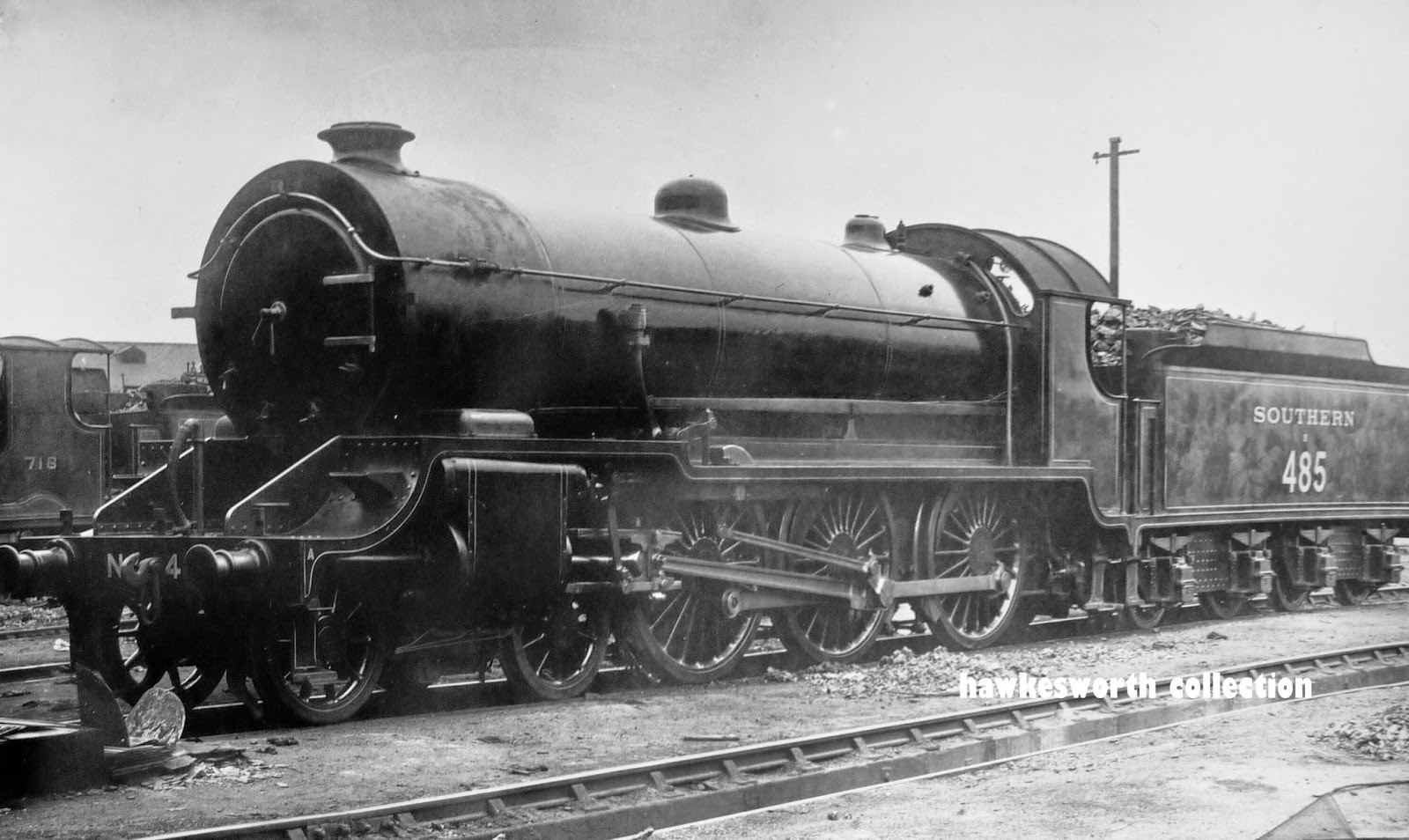
121. LSWR 464 with gleaming new paint.
122. 490
123. B4 Dock Engine LSWR 176.
124. LSWR 273 - A. Beattie 0273 class with Drummond chimney. The -A designation of the duplicate list seems to have been added in the early 1920s, before the 0 prefix became the norm.
125. LSWR 273-A, of the 273 class, on the duplicate list. See 124.
126. LSWR 0278, 0-6-0. Another 0273 Class, this time with stovepipe chimney and 0 prefix.
127. LSWR 50, 46 Class 4-4-2
I assume that many of these works shots were from a bought collection - there is remarkably little activity going on!
128. This composite records the building of Class E14 LSWR 335 in 1907.
129. Peter Smart says:
Photo 129 & 130 Drummond 4-6-0 number 335 under construction at Nine Elms in 1907. By December 1914 this engine had been rebuilt (cannibalised, even) into a Urie H15, of which there are pictures below. This frame has the chalkmark 'e14' visible.
130.
131. These seem to be devices for increasing water heating capacity, a Drummond water-tube firebox. Peter Smart:
Photo 131. The is E14 4-6-0 number 335 nearing completion at Nine Elms in 1907.
A different view of E14 class, E225.
132. A shot earlier in its manufacture. Peter Smart:
Photo 132 lower. The boiler of number 335 being built at Nine Elms in 1907 showing the headers for the firebox cross water tubes, note that these tubes were inclined so the front group on the other side were higher at the front where as in this view the rear group is higher.
133. E335 as a Class E14 when first displayed and photographed in 1907:
135. The same engine was rebuilt (or rather 'recycled') as a H15 in December 1914. This picture shows a superheater so may be a little later.
135. LSWR E335 as a Class H15 with superheater.
and in Southern days
136. This is a finished version of the water-tubes firebox before 1912, when ithis LBSCR engine was converted back to the standard form. Photo archived by the Bluebell Railway. Peter Smart:
The 4-4-0 is a LBSCR engine which has the Drummond type cross water tubes, presumably fitted under some patent agreement between the two railways. This loco had a much smaller boiler than 335! Geoff says: 'Bessborough' was a B4, and entered service with the Drummond water-tube firebox in June 1902. Head Code is Victoria and Brighton via Through Line (aka 'Quarry'). Date no later than June 1910 when the boards were simplified.
137. With thanks from Peter Smart:
Photos 137 and 138 are mock ups to show the differences between the Drummond water tube boiler and the standard fire tube boiler. In 137 holes can be seen for additional fire tubes in both the front tube plate and the firebox tube plate. Holes can also be seen in the firebox sides for the dross water tubes.
138.
139. 343 was a Class K10. This is reproduced from a tiny picture from a montage.Peter Smart:
Photo 139. K10 number 343 fitted with the experimental water tube boiler shown in Photo 137. The K10 was new in December 1901 and built with this boiler. The loco was fitted with a standard fire tube boiler in December 1902 with the loco having completed a mere 4641 miles in the experimental form. The montage also contained photo 137. Question: is this the spark arrester behind the conical smokebox door?
Peter Smart says (many thanks):
Stephen asked, is this the Drummond spark arrester behind a conical smoke box door? The layout certainly has some similarities but I think the baffles here are more to do with the water tube boiler which seems to have a very large free gas area. I have looked several times at the door and cannot make up my mind about it being conical. I tend to think it is not.
The full montage of the water-pipe boiler: numbers are difficult to read even with an eyeglass, but seem to be: top left 683 (date around 1897, note SWR and conical door, the only engine without the water tubes), top centre K10 343, top right Class L11 166, bottom left L11 409, bottom centre K10 343, and bottom right K10 395.
140. Wrecks... Peter Smart notes: L12 number 421 and Beyer Peacock double framed goods No 0351. At Nine Elms in the aftermath of the Salisbury accident on 30 June 1906. The top montage has two pictures of 421 working, with 5 crash aftermath pictures, including the three below.
141. The remains of LSWR L12 421.
421 from the other end
142. LSWR 0351 wreck from the Salisbury crash.
143. Peter Smart:
I believe this to be the new Boiler Shop at Eastleigh Works.
144. Peter Smart: This is a large shed and I think it may well be Eastleigh.
145. Peter Smart: . Beyer single framed goods number 303, built to the order of W.G.Beattie and delivered in July 1874. It was rebuilt by Adams in 1886, duplicated in December 1900 and withdrawn in November 1921. It would appear that the photo was taken before December 1900 (i.e before being on the duplicate list).